Babywearing Safety: Safe Positions and Tips

This article is approved by Yuppo Lab Pediatric Physiotherapist
Published: 19 August, 2026
Updated: 19 August, 2026
Key Takeaways
Using a baby carrier or wrap increases skin-to-skin contact between parent and baby, supporting emotional security through an effective way to carry your baby.
In ergonomic carriers, keeping your baby's legs bent at the knees in an "M" shape supports healthy hip development during the first 6 months.
Correct positioning means preserving your baby's natural "C" curve in the spine and leaving enough space so the chin does not touch the chest.
Babywearing safety starts with keeping your baby close to your body so you can meet their physical needs while continuing with your daily routine. Also known as babywearing, this practice can strengthen the bond between parent and baby from birth. This guide is for tired but loving parents who want to carry their baby safely and in the right position. You will learn ergonomic carrying principles, positions that support healthy hip and spine development, what to look for when choosing a carrier, and safety measures that can help reduce potential risks.


Why does babywearing safety matter?
The benefits of babywearing include supporting a secure parent-child bond, easing crying episodes, and often reducing digestive discomfort, which tends to be most intense during the first three months. When babies are born, they continue to seek the wrapped, moving sensation they experienced in the womb. Skin-to-skin contact and a parent's heartbeat can calm the baby's nervous system and help them feel secure. The American Academy of Pediatrics (AAP) notes that holding babies upright for periods during the day may help ease complaints such as gas. Having your hands free while carrying your baby can also make it easier to manage your daily routine.
Secure attachment and emotional development
Secure attachment and emotional development are supported as your baby continuously feels your warmth, scent, and heartbeat, which can reduce stress hormones and help them experience the world as a safe place. Responding quickly when your baby cries or becomes fussy strengthens the bridge of trust between you. A baby carried on your chest can observe your facial expressions and tone of voice much more closely. This close interaction supports social and emotional development, while also helping parents more easily discover ways to connect with their child and support development.
Physical comfort and digestive support
Physical comfort and digestive support may come from keeping your baby upright in a carrier, which can help reduce stomach acid flowing back into the esophagus, while gentle movement may stimulate bowel activity. Babies with colic or a tendency toward reflux may feel more uncomfortable when lying down. Each step you take while carrying your baby can have a gentle massage-like effect and make it easier to pass gas.

How do you choose an ergonomic baby carrier?
To choose a baby carrier, look for a model that suits your baby's age and weight, supports healthy hip and spine development, has a wide base, and distributes weight evenly across the parent's shoulders. Many different carrier models are available, but not all are anatomically appropriate. Choose ergonomic designs that support your baby from knee to knee instead of narrow-based carriers that place your baby's weight only on the crotch. Parent comfort matters just as much; models with lumbar support and wide, padded shoulder straps can help prevent back pain during extended use.
Baby carrier M position for hip health
The baby carrier M position for hip health means your baby's knees are higher than their bottom, with their legs spread out to the sides like a frog. The International Hip Dysplasia Institute (IHDI) recommends that during the first 6 months, a baby's legs not hang straight down in a carrier but instead be supported in the M position. This position helps the thighbone fit fully into the hip socket, minimizing the risk of hip dislocation.
Below are carrying positions you may safely consider based on your baby's age:
Baby's Age/Development | Recommended Carrying Position | What to Keep in Mind |
|---|---|---|
0–4 months | On the chest, facing the parent | Neck support is needed until your baby has head control. |
4–6 months | On the chest, facing the parent | The legs should be in the frog (M) position. |
6 months and older | Back or hip carry | Your baby should be starting to sit without support. |
These time frames may vary with your baby's pace of development; finding a rhythm that works for you is best.
Baby carrier spine support and the C curve
Baby carrier spine support with a C-curve design means having back-fabric support that allows a newborn's spine to form a natural, gently curved shape without strain. Unlike an adult's S-shaped spine, a baby's spine has a C shape, as it did in the womb. The carrier fabric should gently support your baby's back without forcing them completely flat. Over time, usually when babies begin sitting, the spine develops and gradually changes shape. The head should also be supported until the neck muscles become stronger.

What are the most common babywearing mistakes?
The main babywearing safety points are keeping your baby's face uncovered, making sure the chin does not touch the chest, and positioning the carrier high enough for you to kiss your baby. In the rush of daily life, failing to tighten the carrier enough or positioning your baby too low can strain your lower back and put your baby's safety at risk. The carrier fabric should not cover your baby's face; the airway must always be open and visible. Since the chin touching the chest can make breathing difficult, make sure there is generally a two-finger space between your baby's chin and chest. A forward-facing position is also generally not recommended before 6 months because it can expose your baby to too much stimulation.
When should you ask a professional about babywearing?
Signs that something may be wrong while carrying your baby include persistent crying in the carrier, faster breathing, or asymmetry in the legs or hips. Every baby is different, and some need time to get used to being in a carrier. Starting with short sessions can make adjustment easier. However, if your baby has a condition affecting physical development, was born prematurely, or had a low birth weight, asking your doctor before using any carrier is the safest step. Fussiness in the carrier may resemble signs of colic, so monitor the situation and respond accordingly.
Summary and Next Steps
Ergonomic position: Make sure your baby's knees are higher than their hips (M position).
Open airway: Your baby's chin should not touch their chest, and their nose should not be covered by fabric.
Head support: Especially during the first 4 months, check that your baby's head is adequately supported.
Kissable height: After securing your baby in the carrier, make sure they are high enough for you to easily kiss their head.
This week, try using your carrier during short routines at home. Observe your baby's responses and adjust the fit to their comfort.
When Should You Call the Doctor?
Babywearing is generally safe, but you should contact your doctor if you observe any of the following:
Your baby turns blue or their breathing becomes much faster or wheezy than usual while in the carrier,
You notice marked asymmetry in your baby's thigh folds or limited hip movement, especially in babies younger than 3 months,
Your baby was born before 37 weeks or weighed less than 2,500 grams (5.5 lb), to get approval before use,
Your baby cannot be soothed and reacts extremely whenever placed in the carrier.
This content is for informational purposes only. Always consult your pediatrician for diagnosis and treatment.
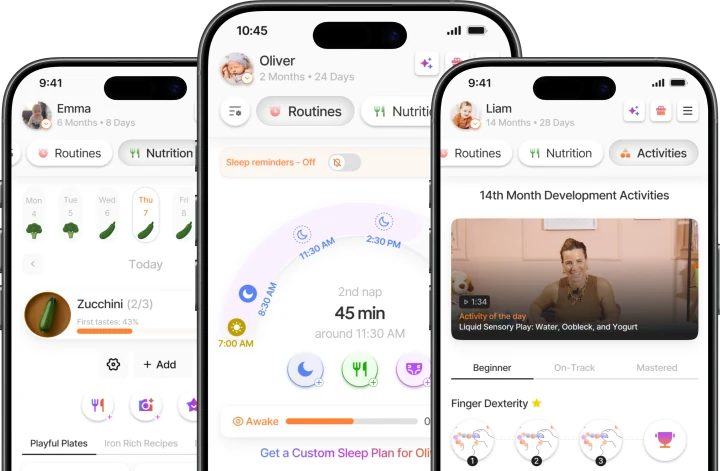
When you are this close to your baby, keeping track of the developmental stage they are in can sometimes feel complicated. During your baby's developmental journey, you can use the Yuppo app's skill analysis feature to assess not only whether your baby can perform physical and emotional skills, but also the level at which they perform them. You can then access expert-approved activity plans using materials at home, matched to that level of challenge.
If your baby falls asleep in the carrier, enter their wake-up time in the app to easily track nap times based on their personal sleep habits and age, then manage changes during the day around your own routine.
Frequently Asked Questions
Is babywearing safe for a newborn?
A newborn may be carried from the first weeks, as soon as the parent feels ready, but the carrier must include an insert or support designed for a newborn's anatomy. Your baby's weight and flexible spine are key factors. Always follow the carrier manufacturer's age and weight limits and make sure the head, neck, and airway are supported.
Is a wrap or structured carrier better for a baby's health?
Whether a wrap or structured carrier is healthier depends on your baby's age and your comfort preferences. Both can be safe options when they provide an ergonomic M position. Wraps often offer a snugger feel during the newborn stage, while structured carriers may be more practical as your baby gets heavier.
How long can a baby stay in a carrier?
A baby's time in a carrier usually consists of periods of 1–2 hours, depending on the baby's comfort and the parent's comfort, although the total daily time may vary. During extended carrying, take frequent breaks so your baby can move, stretch, and change position.
Can babywearing cause hip dysplasia?
Babywearing and hip dysplasia become a concern when a non-ergonomic carrier allows the legs to hang straight down without support behind the knees. Ergonomic carriers that support the correct M position do not negatively affect hip development.
When can a baby face outward in a carrier?
Forward-facing carrying may be used only for short periods from around 6 months, when your baby has full head control and is approaching independent sitting. The World Health Organization (WHO) and other expert organizations recommend facing your baby toward you during the early months to protect them from excessive stimulation.
References

Yuppo Lab
Pediatric Physiotherapist

Yuppo Case
Learn how parallel play supports toddlers and find simple developmental activities for toddlers at home. Follow your child’s progress with Yuppo.

Yuppo Case
Learn why a child growth chart is more useful over time than one weight check—and how Yuppo helps you follow your child's growth. Track growth with Yuppo.

Yuppo Case
Learn why picky eating happens and how to support your child with calm, practical steps. Track meals and nutrition with the Yuppo app.